The South African Mint and the Krugerrand, the first of its kind
Today, we take investment coins for granted. If you want to buy physical gold, you can choose from a range of recognized investment products. Just a few decades ago, however, the situation was completely different.
Gold was concentrated primarily in the reserves of governments, central banks, financial institutions, and among precious metals dealers. For ordinary citizens, there was no simple way to own investment gold that was easily verifiable and widely accepted.
At that time, South Africa was one of the largest gold producers, and the yellow metal was one of its main export commodities. This gave rise to the idea of offering South African gold to private investors through a standardized investment coin.
The result was the Krugerrand, which was introduced to the market in 1967 by the South African Mint and Rand Refinery. The Krugerrand thus became the first modern gold investment coin intended for the general public.
⛏️ The History of Gold Mining in South Africa
In 1886, extensive gold deposits were discovered in the Witwatersrand region in the northeastern part of what is now South Africa. At first, it seemed to be just another of the many gold rushes, similar to those in California or Australia.
However, it soon became clear that the significance of the discovery far exceeded expectations at the time. The Witwatersrand Gold Belt was not an ordinary deposit, but an exceptionally vast geological formation with enormous gold reserves. Foreign capital began to flow into the region, deep mines were established, and within a few decades, the small settlement of Johannesburg became one of the fastest-growing cities in the world.
By the early 20th century, the country had achieved the world’s leading position in gold production. Estimates today indicate that approximately 40 to 50% of all gold mined in human history comes from the Witwatersrand region.

🪙 South African Mint
The development of gold mining transformed not only the country’s economy but also its coinage. The original mint was established in Pretoria as early as 1892 during the presidency of Paul Kruger. After the Second Boer War, the British took control, and from 1923 onward, a branch of the London Royal Mint even operated there, minting gold sovereigns (mint mark SA).
As the gold industry grew in importance, so did the need for domestic coin production. In 1941, the Pretoria Mint became independent, and the South African Mint was established. Together with the Rand Refinery, it laid the foundation from which the gold Krugerrand emerged a quarter of a century later. Thanks to their collaboration, the entire process—from mining and refining to coin minting—takes place within a single country.
🌍 A New Market for Investment Coins
For more than a decade after its launch, the Krugerrand faced no real competition. Starting in 1967, it established a dominant position and gradually became the most widely held investment gold coin of its time.
The Krugerrand’s first competitor was the Canadian Maple Leaf, which debuted in 1979 and attracted investors’ attention primarily due to its high gold purity.
However, a significant turning point came in the 1980s. Sanctions against the apartheid regime restricted imports of Krugerrands into many countries and weakened their previous market position. Other mints around the world gradually filled the resulting void by introducing their own investment coins. In the years that followed, for example, the Chinese Panda (1982), the American Eagle (1986), the Australian Nugget/Kangaroo (1986), the Britannia (1987), and the Wiener Philharmoniker (1989) were introduced.
While in the 1970s the Krugerrand was virtually the only widely available gold investment coin, today investors can choose from a wide range of globally recognized coins, which together form a diverse and well-functioning market for investment coins.
🦌 A Design That Has Stood the Test of Time
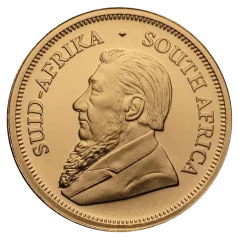
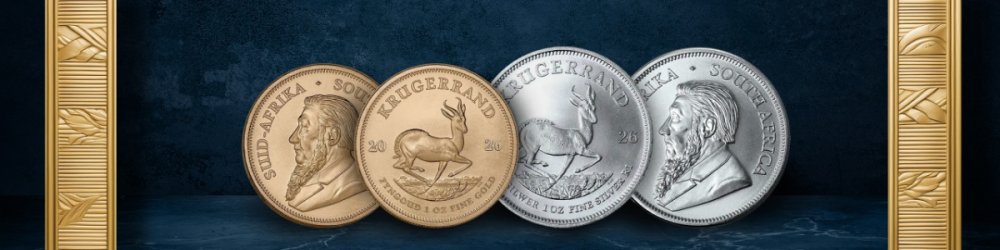
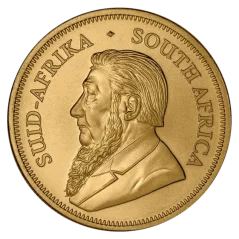
The Krugerrand combines two historical motifs from South African numismatics. The obverse features a portrait of Paul Kruger, president of the former South African Republic (Transvaal). The design was created by German engraver and medalist Otto Schultz for Transvaal coins minted in the late 19th century.
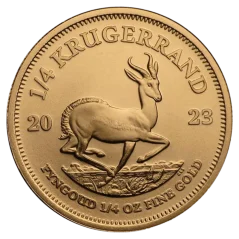
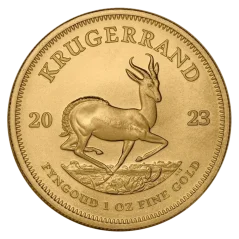
The reverse is dominated by the springbok, whose image was designed by sculptor and medalist Coert Steynberg for South African coins in 1947.
The name “Krugerrand” is a combination of the name Kruger and the word rand. The first part refers to President Kruger, and the second part comes from the name of the South African currency, the rand.
💰 Why doesn’t the Krugerrand have a face value?
Unlike most modern investment coins, the Krugerrand does not have a face value stamped on it. Its value is derived directly from its gold content and the current market price of the metal.
In practice, the absence of a face value is not of significant importance to investors. For investment coins, the face value is usually merely a formal designation related to its status as legal tender and typically represents only a fraction of the actual price of the precious metal it contains.
Thus, the Krugerrand has gone its own way since its inception. Although the coin does not bear a face value, it is official legal tender in South Africa.
🟠 What’s behind the Krugerrand’s unique color?
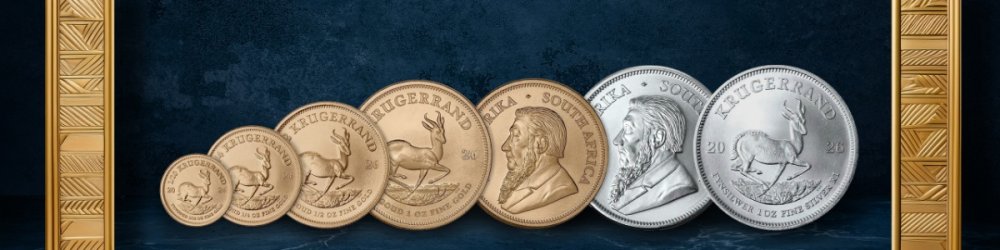
At first glance, the Krugerrand can be recognized by its characteristic warmer shade of gold. Unlike many modern investment coins, it is not minted from pure gold, but from an alloy with a fineness of 916.7/1000 (22 karats), with the remainder consisting mainly of copper. This gives the coin its typical reddish hue and also increases its resistance to mechanical damage and wear.
As with the American Eagle, the weight of the coin indicates its fine gold content. For example, the one-ounce variant contains 31.1 grams of gold, but its total weight is 33.93 grams. The difference is due to the added copper.
🥈 The Krugerrand doesn’t have to be made of gold
Although the Krugerrand has become famous worldwide as a gold investment coin, its silver version has also gained great popularity. The first silver Krugerrand investment coin was minted in 2017 to mark the 50th anniversary of the entire series. It features the same design and is minted from silver with a purity of 999/1000.
🧠 Facts and Trivia
- In 1967, approximately 40,000 Krugerrands were minted. In 1979, when the Canadian Maple Leaf was introduced, annual production of Krugerrands reached nearly 5 million pieces. The first issue of Maple Leaf coins, meanwhile, numbered approximately 1 million coins.
- Since 1933, private ownership of investment gold had been prohibited in the U.S. After this restriction was lifted in 1975, the Krugerrand became one of the most accessible ways for U.S. citizens to once again invest in physical gold. The U.S. government did not introduce the Gold Eagle investment coins until 1986.
- South Africa has dozens of historic gold mines, but today only a limited number of deep deposits remain active. Nevertheless, it ranks among the countries with the most significant history of gold mining in the world.
- The coin’s name and its obverse side commemorate Paul Kruger, president of the South African Republic (Transvaal) from 1883 to 1900. The Krugerrand was not created until nearly seven decades after he left office.
- The springbok (literally “jumping antelope”) is famous for its characteristic high leaps known as “pronking.” Although these leaps are typical of the species, their actual purpose remains unclear to this day.
Recommended products6
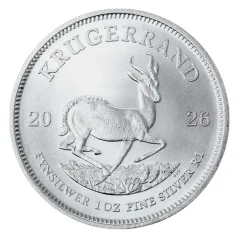
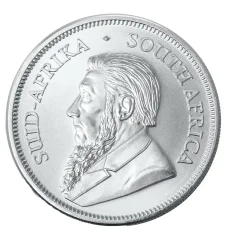
Silver coin Krugerrand 1 Oz | 2026
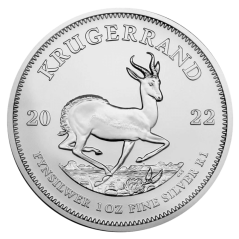
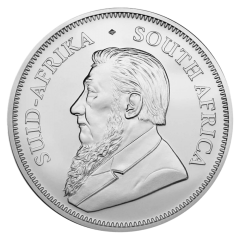
Silver coin Krugerrand 1 Oz
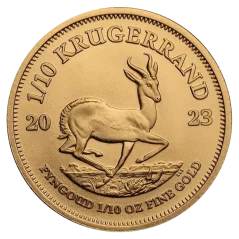
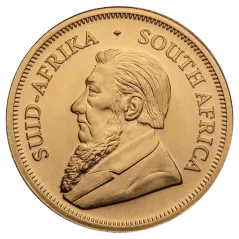
Gold coin Krugerrand 1/10 Oz
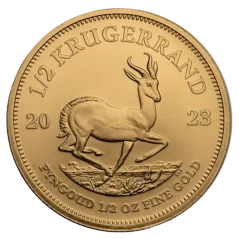
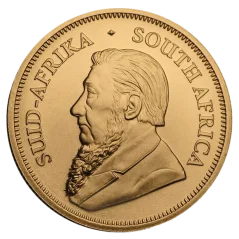
Gold coin Krugerrand 1/2 Oz
Gold coin Krugerrand 1 Oz