The U.S. Mint & American Eagle – Symbols of the United States in Pure Metal
The United States Mint is one of the world’s most respected mints. Although it cannot boast a thousand-year-old tradition like some European mints, it has managed to build extraordinary market confidence.
Its American Eagle investment program ranks among the very best—not only because of the quality of its craftsmanship, but also because of the stability of the country it represents. Coins and banknotes have never been merely a medium of exchange for the United States. From the very beginning, they have also carried symbolic meaning—serving as a reminder of sovereignty, unity, and patriotism.

🗽 U.S. Mint: An Institution Younger Than Its Ideals
The U.S. Mint was established in 1792 as one of the first federal institutions of the newly formed United States. At that time, the young republic faced a fundamental challenge—unifying the monetary system and gaining the trust of both its citizens and foreign trading partners.
Unlike in Europe, where monetary systems had evolved over centuries, the U.S. Mint was built from the ground up. That is precisely why, from the very beginning, it prided itself on transparency, precise manufacturing processes, and reliability—values that remain associated with the U.S. Mint to this day.
🕰️ A Brief History of American Coinage
17th–18th Centuries – Colonial Currency
A mix of European coins, Spanish dollars, and commodities (e.g., tobacco, sugar); each colony had its own customs.
1793 – First Coinage
The first official American coins were copper cents (Flowing Hair cent).
1837 – Coinage Reforms and Currency Standardization
Congress unified weight and metal standards, thereby eliminating colonial differences.
1861–1865 – Civil War
Precious metals became very scarce; paper currency (paper notes) was introduced.
1933 – Abolition of the Gold Standard
President Franklin D. Roosevelt issued an executive order prohibiting the public from owning gold coins.
1971 – End of Silver Circulation Coins
Circulation coins were subsequently minted only from a copper-nickel alloy.
1986 – Launch of the American Eagle investment program
The U.S. Mint began minting gold and silver investment coins for the general public; the Liberty and eagle motifs became iconic.
2021 – Design update
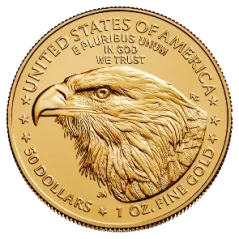
To mark the program’s 35th anniversary, the reverse sides of the gold and silver coins were redesigned.
🪙 U.S. Mint Locations and Products
Today, the U.S. Mint operates several facilities across the United States. Its operations began in 1792 with the Philadelphia Mint, which was gradually joined by branches in New Orleans (1838), Denver (1906), San Francisco (1937), and West Point (1957):
- Investment coins – gold and silver (American Eagle, American Buffalo)
- Circulation coins – for everyday payments
- Commemorative and collector coins – limited editions
- Medals and awards – for government institutions and collectors
🌟 American Eagle Investment Coins: A Market Staple
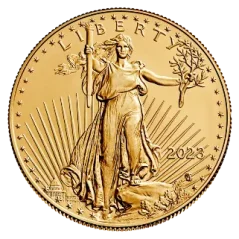
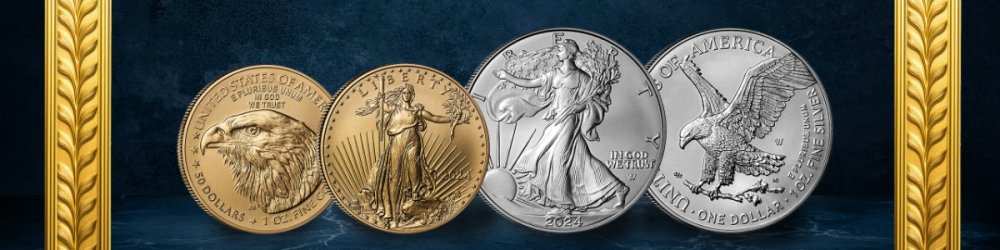
The gold and silver American Eagle coins are among the world’s most famous investment coins. For decades, they retained their traditional obverse and reverse designs, a tradition that changed in 2021.
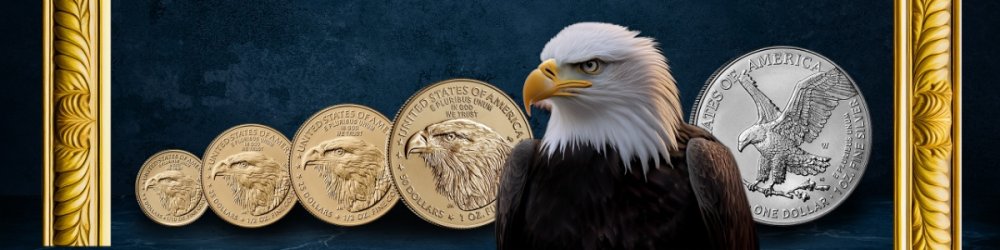
- The gold version now features a detailed portrait of a bald eagle.
- The silver version depicts a soaring eagle with an oak branch—a symbol of continuity and protection of the future.
- The obverse sides remain faithful to the 1986 classic and its historical models.
The obverse of the gold coin is based on the iconic design by August Saint-Gaudens from 1907, originally created for the twenty-dollar Double Eagle. Liberty is shown here walking forward with a lit torch—a symbol of light and progress.
The silver coin features the Walking Liberty motif by Adolph Weinman. He created the figure of Liberty walking toward the sun and draped in the American flag in 1916 for the half-dollar coin. The allegory conveys a message of freedom, strength, peace, and prosperity.
🧡 The characteristic "honey" color of gold
American Eagle gold investment coins are not pure 24-karat gold. They contain 91.67% gold, with the remainder consisting of silver and copper. Thanks to this alloy, the coins are more resistant to damage and have the typical warm, rich color that investors and collectors know and appreciate.
It is also important to note that despite the addition of other metals, the coins always contain exactly the amount of pure gold corresponding to their stated weight (e.g., 1 ounce, 1/2 ounce, 1/4 ounce, etc.). The total weight of the coin is therefore always slightly higher, as it includes the weight of this additional alloy.
🦅The Eagle as an Archetype
The bald eagle is one of the most powerful symbols of the United States. For the indigenous peoples of America, it represented a spiritual connection to the heavens, protection, and courage. Its feathers held ritual significance and were used in sacred ceremonies.
For the newly formed republic, this untamed predator became a symbol of freedom and independence. This species, endemic to North America, personified the strength, vigilance, and authority of the young nation. Even without directly adopting Native American symbolism, the bald eagle became a universally understood message—both at home and abroad.
📌 A Brief Fact About the Mysterious Fort Knox
When Americans talk about absolute security, they often say, “It’s like Fort Knox.” This expression has long outgrown its original meaning and become part of modern folklore.
Fort Knox in Kentucky serves as the main gold repository of the United States. A massive steel-reinforced concrete structure, armored doors weighing dozens of tons, and round-the-clock military protection have made it a symbol of inviolability.
Yet it is precisely this extreme secrecy that has long fueled conspiracy theories. The public has virtually no access to the interior, and a complete audit of the gold reserves has been the subject of debate for decades. This has led to doubts as to whether all the declared gold is actually stored at Fort Knox, or whether part of it was sold or moved elsewhere in the past.
Recommended products3

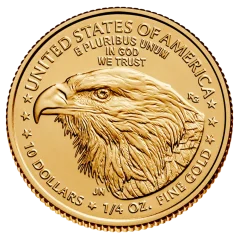
Gold coin American Eagle 1/4 Oz
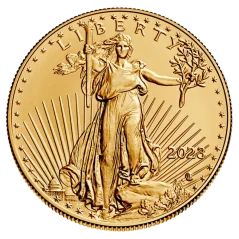
Gold coin American Eagle 1/2 Oz